
China Heritage Tourism Market Size
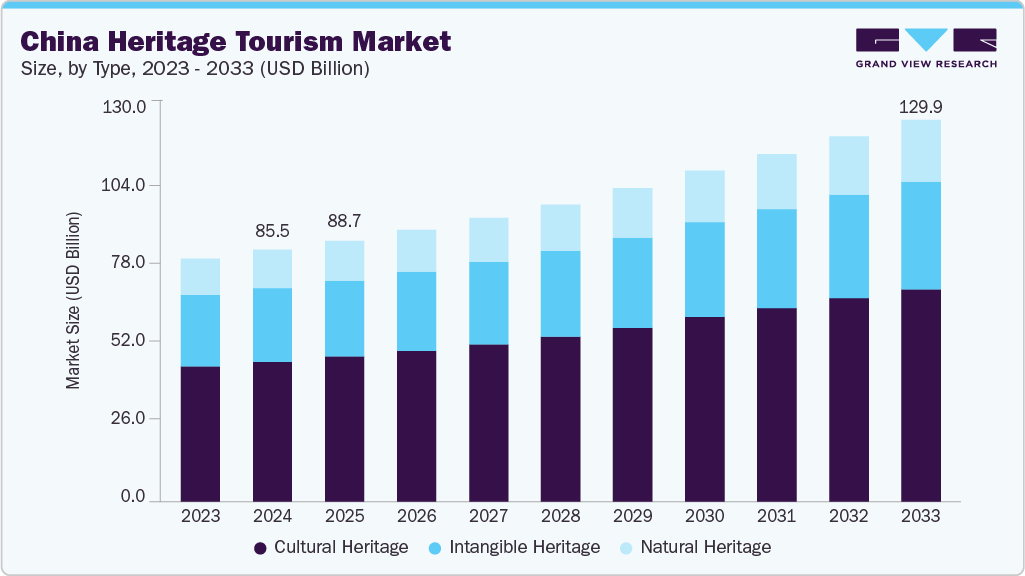
China Heritage Tourism Market Summary
The China heritage tourism market size was estimated at USD 85.52 billion in 2024, and is projected to reach USD 129.88 billion by 2033, growing at a CAGR of 4.9% from 2025 to 2033. The market growth is attributed to the deep sense of cultural heritage, robust government initiatives, and growing global demand for authentic cultural experiences.
Key Market Trends & Insights
- The China heritage tourism market size was valued at USD 85.52 billion in 2024.
- The China heritage tourism market is anticipated to witness a CAGR of 4.9% from 2025 to 2033.
- By type, the cultural heritage segment held the largest market share of 55.5% in 2024.
- By age group, the 51 to 70 years segment held the largest market share in 2024.
- By booking mode, the offline segment held the largest market share in 2024.
Market Size & Forecast
- 2024 Market Size: USD 85.52 Billion
- 2033 Projected Market Size: USD 129.88 Billion
- CAGR (2025-2033): 4.9%
Both domestic and international tourists are increasingly captivated by China’s vast array of historical landmarks, including the Great Wall, the Forbidden City, the Terracotta Warriors of Xi’an, and the ancient water towns of Jiangnan. Recognizing the strategic importance of cultural tourism, the Chinese government has prioritized the preservation and revitalization of historical sites while investing heavily in infrastructure, digital integration, and multilingual services to enhance visitor access and engagement.
The China heritage tourism market is also driven by rising domestic income levels, increasing interest in cultural identity, and strong government support for preserving and promoting historical sites. Rapid urbanization has fueled nostalgia and demand for traditional experiences. Digital platforms and smart tourism technologies also make heritage sites more accessible and engaging. Additionally, policies such as the Belt and Road Initiative encourage cultural tourism as a soft power tool.
China’s heritage tourism market is propelled by a growing middle class income which seek for unique and meaningful travel experience especially rooted in history. Similarly, educational initiatives and school curricula that emphasize cultural heritage foster early interest in traditional tourist sites. Improved transportation infrastructure enhances access to remote historical destinations. Furthermore, the rise of experiential tourism trends encourages immersive visits to ancient towns, temples, and UNESCO sites.
China Heritage Tourism Market: Consumer Survey & Insights
According to the data published by the Government of China in November 2024, approximately 94.62 million international visitors entered China during the first three quarters of the year, marking a 78.8% increase compared to the same period in 2023. The China International Travel Mart 2024, hosted at the National Exhibition and Convention Center in Shanghai, welcomed over 1,000 global exhibitors and nearly 600 international travel buyers representing more than 80 countries and regions. The event aimed to boost inbound tourism by highlighting innovative travel offerings and routes. Moreover, according to the data published in November 2024, over 10 million tourists visit the heritage sites such as the Great Wall of China. The Badaling section of the site is historic and culturally significant. Major tourist attractions in China include UNESCO heritage sites such as the Forbidden City, the Great Wall of China, the Summer Palace, the Leshan Giant Buddha, and the Zhangjiajie Forest.
Type Insights
Cultural heritage tourism accounted for a share of 55.5% in the overall China heritage tourism industry in 2024. China’s cultural heritage tourism is propelled by its vast array of historical sites, ancient traditions, and rich artistic legacies. Visitors are drawn to world-famous landmarks such as the Great Wall, Forbidden City, and numerous UNESCO World Heritage sites, which offer deep insights into China’s civilization and cultural evolution. The Badaling section of the Great Wall of China holds the historic and cultural significance, attracting tourists. This form of tourism allows travelers to engage with authentic cultural experiences, festivals, and traditional crafts, fostering a strong connection to China’s past.

The natural heritage tourism market is expected to grow at a CAGR of 5.5% from 2025 to 2033, reflecting rising demand for eco-conscious and nature-based travel experiences. Natural heritage tourism in China is driven by the country’s diverse and breathtaking natural landscapes, ranging from the towering Himalayas to serene lakes and vast forests. The preservation of unique ecosystems and national parks attracts nature enthusiasts and eco-tourists seeking outdoor adventures and tranquility. Heritage sites such as Jiuzhai Valley National Park, renowned for its stunning jagged alpine mountains and rich historical importance, draw nature enthusiasts with its exceptional natural beauty, and is home to more than 140 bird species. This segment emphasizes environmental conservation while providing opportunities to explore China’s rich biodiversity and scenic beauty, making it a vital component of the heritage tourism market.
Age Group Insights
Travelers in the 51-70 age group accounted for a share of 58.7% in the overall Chinese heritage tourism industry in 2024. The travelers aged 51 to 70 often seek meaningful and enriching experiences, making heritage tourism particularly appealing to them. This group values cultural depth, historical exploration, and leisurely travel, which allows them to connect with China’s rich traditions and ancient sites at a comfortable pace. Their preference for well-organized tours and immersive storytelling helps sustain demand for heritage destinations that offer educational and reflective experiences.
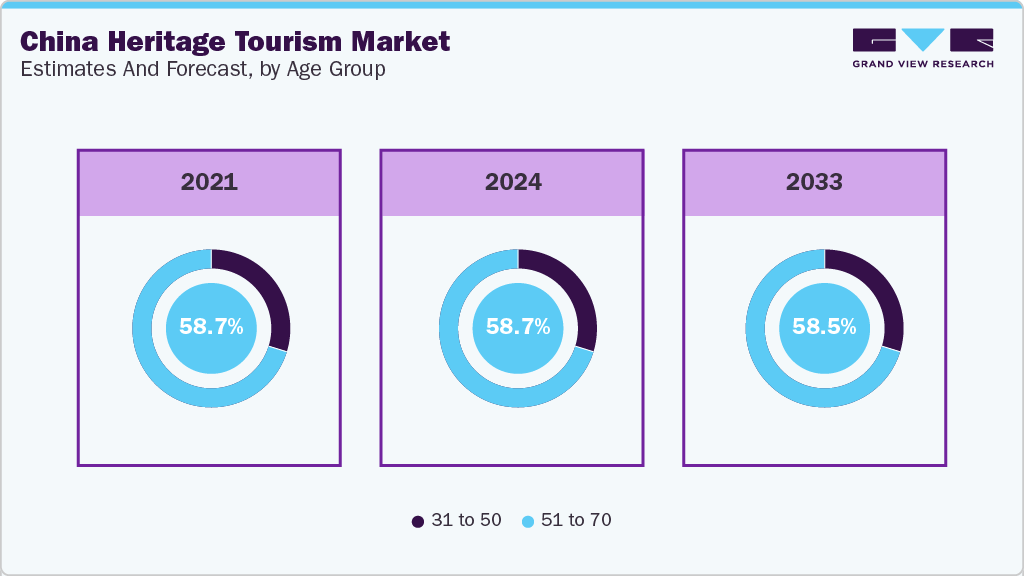
Travelers in the 31-50 age group in China heritage tourism industry is expected to grow at a CAGR of 5.6% from 2025 to 2033. The 31 to 50 age group is driven by a balance of cultural curiosity and adventure, often combining heritage exploration with active travel. This segment tends to look for unique, authentic experiences that provide both relaxation and engagement with local culture. They are more likely to seek customized itineraries and innovative tourism products, fueling the development of heritage tourism offerings that blend history with modern convenience and creativity.
Booking Mode Insights
Booking through offline mode generated a revenue share of 68.8% in 2024. Many travelers, especially older visitors or those preferring personalized services, still rely on offline booking methods such as travel agencies and tour operators. This traditional approach offers face-to-face interaction, tailored advice, and added security, which can be crucial for complex heritage tours. Offline booking also helps build trust and ensures travelers receive detailed guidance on cultural sites, enhancing their overall experience.

Booking through online mode is expected to grow at a CAGR of 6.0% from 2025 to 2033. The rise of digital platforms has transformed how many tourists plan their heritage trips in China, with online booking offering convenience, speed, and access to extensive information. Travelers can easily compare options, read reviews, and customize their itineraries from anywhere. This method appeals particularly to younger and tech-savvy tourists who value flexibility and real-time updates, driving growth in China’s heritage tourism market through increased accessibility and innovation.
Key China Heritage Tourism Company Insights
The China heritage tourism market is diverse and highly competitive, featuring a mix of major national operators alongside numerous regional and specialized companies. Key players in this industry include China International Travel Service (CITS), China Youth Travel Service (CYTS), Caissa Touristic, Beijing Guide International Travel Service, Spring Tour, CTS Travel Group, Tuniu Corporation, Shanghai Jin Jiang International Travel, Dragon Trail Interactive, and many others. This fragmentation reflects the wide range of services and regional expertise available to cater to both domestic and international heritage tourists.
-
Beijing Guide International Travel Service is a China-based Destination Management Company with over 20 years of experience, specializing in creating personalized, culture-rich travel experiences across China. Customized itineraries include iconic destinations such as Beijing, Xi’an, Hangzhou, Lijiang, and lesser-known ancient towns, featuring visits to historic temples, traditional ceremonies, museum tours, and UNESCO World Heritage sites. The company offers immersive cultural activities such as calligraphy lessons, traditional tea ceremonies, martial arts workshops, local artisan visits, and participation in ancient festivals, ensuring travelers gain an authentic and meaningful connection to China’s heritage.
-
CITS (China International Travel Service) is a Beijing-based travel agency specializing in fully customized private and small-group tours throughout China. Serving both international tourists and domestic travelers, CITS focuses on flexibility, meticulous planning, and personalized experiences. Their offerings include bespoke heritage and cultural itineraries, private chauffeur-guided tours, luxury vehicle options, multi-generational family travel packages, and accessible tours designed to accommodate guests with mobility requirements.
Key China Heritage Tourism Companies:
- China International Travel Service (CITS)
- China Youth Travel Service (CYTS)
- Caissa Touristic
- Beijing Guide International Travel Service
- Spring Tour
- CTS Travel Group
- Tuniu Corporation
- Shanghai Jin Jiang International Travel
- Dragon Trail Interactive
- Hutong Tour
Recent Developments
-
In December 2024,Fosun Tourism announced plans to privatize its tourism unit, with the aim of streamlining operations and reducing debt.
-
In September 2024, Poland-based eSky Group acquired the Thomas Cook brand (excluding its China operations) from Fosun for around USD 40.8 million, aiming to leverage its renowned legacy and extensive flight inventory to expand into Western Europe.
China Heritage Tourism Market Report Scope
|
Report Attribute
|
Details
|
|
Market size value in 2025
|
USD 88.73 billion
|
|
Revenue forecast in 2033
|
USD 129.88 billion
|
|
Growth rate
|
CAGR of 4.9% from 2025 to 2033
|
|
Actual data
|
2021 – 2024
|
|
Forecast period
|
2025 – 2033
|
|
Quantitative units
|
Revenue in USD million/billion and CAGR from 2025 to 2033
|
|
Report coverage
|
Revenue forecast, company ranking, competitive landscape, growth factors, and trends
|
|
Segments covered
|
Type, age group, booking mode
|
|
Country scope
|
China
|
|
Key companies profiled
|
China International Travel Service (CITS); China Youth Travel Service (CYTS); Caissa Touristic; Beijing Guide International Travel Service; Spring Tour; CTS Travel Group; Tuniu Corporation; Shanghai Jin Jiang International Travel; Dragon Trail Interactive; Hutong Tour
|
|
Customization
|
Free report customization (equivalent up to 8 analysts working days) with purchase. Addition or alteration to country, regional & segment scope
|
|
Pricing and purchase options
|
Avail customized purchase options to meet your exact research needs. Explore purchase options
|
China Heritage Tourism Market Report Segmentation
This report forecasts revenue growth at the country level and provides an analysis of the latest industry trends and opportunities in each of the sub-segments from 2021 to 2033. For this study, Grand View Research has segmented the China heritage tourism market based on type, age group, and booking mode:
-
Type Outlook (Revenue, USD Billion, 2021 – 2033)
-
Cultural Heritage
-
Natural Heritage
-
Intangible Heritage
-
-
Age Group Outlook (Revenue, USD Billion, 2021 – 2033)
-
30 And Under
-
31-50
-
51-70
-
70 and Above
-
-
Booking Mode Outlook (Revenue, USD Billion, 2021 – 2033)
Frequently Asked Questions About This Report
b. The China heritage tourism market size was estimated at USD 85.52 billion in 2024 and is expected to reach USD 88.73 billion in 2025.
b. The China heritage tourism market is expected to grow at a compound annual growth rate (CAGR) of 4.9% from 2025 to 2033 to reach USD 129.88 billion by 2033.
b. Cultural Heritage accounted for a revenue share of 55.5% in 2024, driven by its ancient civilization, iconic historical landmarks, and strong government investment in cultural preservation and promotion.
b. Some key players operating in the China heritage tourism market include China International Travel Service (CITS), China Youth Travel Service (CYTS), Caissa Touristic, Beijing Guide International Travel Service, Spring Tour, CTS Travel Group.
b. Key factors driving market growth in the China heritage tourism market is fueled by its vast historical legacy, including ancient dynasties, UNESCO World Heritage sites, and preserved cultural traditions. Government support, rising domestic tourism, and global interest in Chinese culture further accelerate market growth.
link




:max_bytes(150000):strip_icc()/120325-oprah-soc-860665f9054143eeb0dd846dc28fa740.jpg "Oprah-Approved Clothes, Shoes, and Bags Start at on Amazon")
