
Aligning online images and realities beyond the hype for sustainable heritage tourism
Results of ODI analysis
Following the standardized NLP workflow detailed in previous section, the analysis of the collected UGC revealed the core thematic structure of Zhongyang Street’s ODI. Latent Dirichlet Allocation (LDA) topic modeling extracted five distinct thematic categories: (1) Russian-style Cultural Experience, (2) Architectural Landmarks and Heritage, (3) Visitor Leisure Activities, (4) Seasonal Atmosphere and Environment, and (5) Old Street Consumption Experience. A subsequent combined analysis of keyword frequency (derived from TF-IDF) and sentiment scores (calculated via SnowNLP) was conducted to assess each theme’s salience and affective orientation within the online discourse, as visualized in Fig. 5.

The most dominant theme was “Russian-style Cultural Experience”, characterized by the highest keyword frequency and the most favorable sentiment values. Representative keywords included “architecture” (813 occurrences), “pedestrian street” (470), “Russia” (344), and “charming style” (293), all of which are closely associated with the street’s Russian heritage. Notably, sentiment scores for terms such as “Russian style” (0.94), “charming style” (0.95), and “Russia” (0.93) consistently exceeded 0.92, indicating strong emotional resonance with the district’s historical and cultural ambiance.
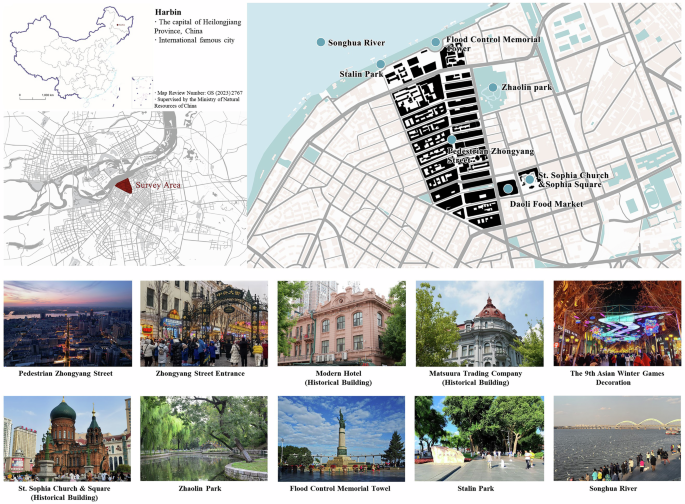
The second theme, “Architectural Landmarks and Heritage” reflected visitors’ aesthetic engagement with both Western architectural styles and Chinese historical monuments. Frequent terms included “style” (299), “European-style” (236), “Renaissance” (105), “Flood Control Monument” (194), and “Baroque” (191). Sentiment scores generally surpassed 0.91, indicating high levels of aesthetic appreciation.
The third theme, “Visitor Leisure Activities” focused on casual tourism and social interaction behaviors. Keywords such as “daka” (289), “photo-taking” (177), and “delicious” (160) highlighted Zhongyang Street’s role as a social media hotspot. However, this theme exhibited the lowest average sentiment score (approximately 0.83), with negative reviews citing overcrowding and mediocre service quality as common concerns.
The fourth theme, “Seasonal Atmosphere and Environment” captured perceptions related to winter festivities and climatic aesthetics. Common terms included “ice sculptures” (102), “winter” (116), and “lively” (134). The average sentiment score reached 0.86, indicating generally positive evaluations of the seasonal atmosphere.
The fifth theme, “Old Street Consumption Experience” encapsulated perceptions of commercial activities intertwined with historical authenticity. Key terms included “century-old” (225), “old street” (128), “culture” (114), “smoked sausage” (96), and “cost-effective” (110). Crucially, “cost-effective” not only appeared frequently but also registered the highest sentiment score (0.99), reflecting strong approval of affordable yet culturally immersive consumption experiences.
In summary, the themes “Russian-style Cultural Experience” and “Old Street Consumption Experience” emerged as the most prominent and positively perceived, reinforcing Zhongyang Street’s dual identity as both a cultural landmark and a commercial destination. In contrast, “Visitor Leisure Activities” received more mixed affective responses, highlighting potential shortcomings in crowd management and service delivery that merit managerial attention.
Results of DIG survey and assessment
Tourist satisfaction surveys revealed overall positive evaluations of Zhongyang Street, with all 13 indicators averaging above 3.9. Among the three dimensions, Tourist Attractions (TA) scored the highest, Tourist Facilities (TF) showed moderate consistency, while Tourist Environment (TE) underperformed (Fig. 6).

DIG and satisfaction survey results.
Within the TA dimension, TA2 “distinctive architectural styles” (4.41) and TA4 “symbolic historical landmarks” (4.25) emerged as top performers, highlighting the street’s strengths in architectural aesthetics and historical identity. The TF dimension exhibited internal variation: although TF3 “shopping experience” received the highest rating (4.07), TF2 “public service facilities” scored lowest (3.95), suggesting that while the commercial atmosphere is well-received, basic amenities (e.g., restrooms and seating) require improvement. The TE dimension consistently underperformed, with TE1 “street and pedestrian environment” recording the lowest score (3.91), and TE3 “seasonal landscapes and events” also falling below average (4.03). Although TE5 “wayfinding system and integrated services” received a relatively favorable rating (4.17), most indicators within this dimension reflected dissatisfaction with environmental conditions.
DIG analysis revealed a clear predominance of negative perception gaps, with positive gaps concentrated in a few high-performing indicators. Across all 13 items, over 90 respondents on average reported negative gaps, nearly twice as many as those reporting positive gaps, indicating a widespread perception that on-site experiences did not meet online-induced expectations. Negative gaps were particularly pronounced in the TE dimension, where TE2 “historical and cultural atmosphere”, TE3 “seasonal landscapes and events” and TE4 “resident interaction and tourism ambience” exhibited mean differences of 1.622, 1.598 and 1.596 points, respectively, suggesting major shortcomings in the actual delivery of seasonal, cultural and native experiences compared to their online portrayal. Conversely, notable positive gaps appeared in TF2 “public service facilities” (1.900), TE2 “historical and cultural atmosphere” (1.609), and TF4 “cultural and creative product design” (1.593), indicating that certain cultural expressions exceeded expectations. Crucially, TF2: “public service facilities” achieved the largest positive gap (1.900), demonstrating that high-quality basic services can deliver unexpected satisfaction. Notably, TE2 (historical and cultural atmosphere) recorded high mean values for both the positive gap (1.609) and the negative gap (1.622), indicating a significant perceptual heterogeneity among tourists regarding the authenticity and transmission of the cultural experience.
Comparative analysis of satisfaction scores and DIG data revealed distinct structural patterns across the three dimensions. TA emerged as the core strength, characterized by consistently high satisfaction, underscoring the critical role of visual and cultural assets in shaping positive destination images. TF displayed “functional stability with internal divergence”. While overall satisfaction remained steady, the contrast between TF4’s negative gap and TF2’s positive gap revealed a tension between infrastructural shortcomings and strengths in creative experience design. TE constituted the primary area of dissatisfaction, marked by the highest frequency and intensity of negative gaps. This identifies it as the critical weak link requiring urgent improvements in environmental maintenance, cultural interpretation, and service integration.
In summary, Zhongyang Street exhibits strong appeal through its heritage attractions and cultural consumption opportunities. However, deficiencies in environmental management and service infrastructure remain major constraints. This imbalance highlights the need for holistic strategies to align digital image expectations with on-site experiences more effectively.
Results of PLS-SEM modeling
PLS-SEM modeling was applied to examine how positive and negative perception gaps affect tourist satisfaction. Positive gaps (PG) and negative gaps (NG) were modeled as three first-order latent variables each (PG_TF, PG_TA, PG_TE and NG_TF, NG_TA, NG_TE), derived from 13 observed indicators. These gap variables directly influence dimensional-specific satisfaction (SAT_TF, SAT_TA, SAT_TE), which together form the second-order construct of overall satisfaction (SAT) (Fig. 7).

The measurement model demonstrated satisfactory reliability and validity (Table 5). All outer loadings exceeded 0.70, and both Cronbach’s α and Composite Reliability (CR) values were above 0.70, indicating strong internal consistency62. Convergent validity was established with Average Variance Extracted (AVE) values exceeding 0.5067, and discriminant validity was confirmed by Heterotrait-Monotrait (HTMT) ratios below 0.9068 (Table 6). In the structural model, explanatory power varied across dimensions, SAT_TA (R² = 0.643) and SAT_TE (R² = 0.598) exhibited higher explanatory power, whereas SAT_TF (R² = 0.483) was comparatively lower. The second-order SAT construct achieved R² = 1.000 as it is fully derived from dimensional satisfactions (Table 7).
Path coefficient analysis confirmed the asymmetric effects between perception and negative gaps on satisfaction (Table 8). The p-value of all paths is less than 0.05, indicating a significant impact relationship between each path. Positive gaps enhanced satisfaction, with strongest impacts from PG_TF → SAT_TF (β = 0.339) and PG_TE → SAT_TE (β = 0.322), while PG_TA → SAT_TA was weaker (β = 0.199). This indicates that, in the Zhongyang Street context, pleasant surprises in tourist facilities and environment contribute more to satisfaction than visual or cultural attractions alone. Negative gaps severely reduced satisfaction, particularly NG_TA → SAT_TA (β = -0.703), followed by NG_TE → SAT_TE (β = -0.574) and NG_TF → SAT_TF (β = -0.485). This suggests that unmet expectations in attractions (e.g., aesthetics, symbolic landmarks, or historical experience) are the most damaging to satisfaction.
Interestingly, the impact rankings form a reverse symmetry: the stronger a positive effect in one dimension, the weaker its corresponding negative effect (e.g., TF), and vice versa. This reflects tourist’ differing psychological responses to surprises and disappointments, and the disappointments are more damaging. The coefficient magnitudes suggest that negative perception gaps have greater influence than positive ones, highlighting the asymmetric effect emphasized by Expectation Disconfirmation Theory (EDT).
Indirect path analysis (Table 9) further revealed the heterogeneity of dimensions. Among positive paths, PG_TF (0.123) and PG_TE (0.120) most significantly enhanced overall SAT, while PG_TA (0.076) trailed. Among negative paths, NG_TA (−0.267) exerted the strongest dampening effect, exceeding NG_TE (−0.214) and NG_TF (−0.176). These results reinforce a dimension-based priority: facilities and environments generate positive surprises, whereas attractions, when failing expectations, severely diminish satisfaction. Managing attraction-related gaps, especially symbolic or aesthetic ones, should thus be a strategic focus.
Analysis at the factor-level (Table 10) reveals three key mechanisms. Firstly, attractions function as high-impact levers. TA2 (architectural style, β = −0.2355) and TA3 (resource integration, β = −0.2390) showed strong negative effects, reflecting high-expectation, high-disappointment dynamics. Notably, TA3’s negative impact quadrupled its positive effect (0.0667), highlighting severe aesthetic disillusionment when expectations fail. Conversely, TA4 (symbolic landmarks, β = 0.0676) reinforced its role in exceeding expectations. In this sense, attractions operate as sensitive amplifiers: they are capable of generating high value, but equally prone to deep backlash when perception gaps widen. For culturally-driven destinations, managing expectation accuracy and curating authentic, symbolically potent experiences is therefore critical.
Secondly, the environment serves as a stabilizing foundation. On the positive path, TE4 (seasonal atmosphere, β = 0.1074) and TE5 (wayfinding and integrated services, β = 0.1068) both contribute strongly among all the indicators, indicating their role in enhancing baseline satisfaction. On the negative side, TE5 (wayfinding and integrated services, β = −0.1841) and TE1 (street and pedestrian environment, β = −0.1741) emerge as significant pain points, underscoring the need for systemic improvement in basic services. Unlike the attraction dimension, environmental elements set the conditions for a stable and coherent experience improvement, their surprise enhance more on satisfaction.
Finally, facilities function as elastic, low-volatility buffers. TF2 (public service facilities, β = 0.1041) exhibits the highest positive effect, suggesting it offers a “quick win” for enhancing satisfaction. Meanwhile, TF1 (accommodation and dining, β = −0.1554) shows mild negative effects, functioning as a predictable, low-volatility support dimension. Overall, facility-related indicators show more moderate, symmetric effects, suggesting they are perception buffers rather than central levers. Their influence lies in supporting or sustaining satisfaction, rather than directly shaping emotional highs or lows. This elasticity and manageability make them ideal targets for incremental upgrades in urban tourism planning.
In summary, most indicators exhibit stronger negative than positive effects, forming a pronounced asymmetric impact structure. Particularly, TA items, TE5, and TE1 are critical negative leverage points. These findings confirm that in the context of Zhongyang Street, mitigating expectation–experience discrepancies, especially in cultural and environmental dimensions, is more crucial than merely providing delight. Strategic improvements should thus prioritize closing negative gaps, especially in areas where symbolic, functional, or experiential quality is failing to meet expectations.
Results of the IDP Framework
Applying the IDP Framework revealed distinct patterns. The SGS Matrix (Fig. 8) categorized the factors, while the OIV Index (Table 11) provided a clear prioritization.

Results of the IDP Framework: SGS Matrix Diagnosis.
Tourist Facilities (TF) exhibit suboptimal satisfaction scores yet demonstrate positive perception gaps (Fig. 8 and Table 11). All four variables reside in the “Core Experience Failure” quadrant. This indicates that although the on-site experience (OPI) was better than the low online expectations (ODI), the actual experience itself remains unsatisfactory (low satisfaction), signaling a fundamental shortage in service delivery. Future efforts should focus on dramatically enhancing the OPI (offline experience). Among them, TF1 (ranked 8th), TF3 (11th), and TF4 (6th) show relatively higher satisfaction. Conversely, TF2 (ranked 12th) combines positive gaps with extremely low satisfaction, implying severe, ongoing deficiencies in fundamental infrastructure, convenience services, and informational guidance.
Tourist Attractions (TA) demonstrate robust performance, with all elements exceeding satisfaction means. However, they are categorized as “Online Hype Risk”, forming the destination’s online perceptual foundation. TA1 (5th), TA2 (7th), and TA4 (3rd) reinforce spatial-cultural stability, but the actual experiences (OPI) slightly lag the even higher online expectations (ODI). This suggests a risk of backlash from over-promotion and calls for managing online authenticity (ODI) alongside improving narrative expression. Notably, TA3 (ranked 1st in priority) also falls into this quadrant, revealing critical gaps in attractions’ connectivity and intergration despite its high satisfaction, highlighting it as the most severe case of “Online Hype Risk”.
Tourist Environment (TE) displays acute structural weaknesses with polarized performance. High-priority variables demand urgent intervention. TE1 (ranked 2nd), with low satisfaction, falls into the “Dual Intervention Need” category. This reflects persistent issues with crowding and sanitation that are failing on-site (OPI) and being over-promised online (ODI), undermining the visitor experience. Similarly, TE3 (4th) and TE2 (9th) fall in this same high-risk quadrant, highlighting a need for enriched cultural programming. Conversely, TE5 (10th) and TE4 (13th), both within the “Online Hype Risk” group, received above-average satisfaction, yet still reveal misalignment between advertised imagery and lived experience, especially regarding humanistic and atmospheric elements.
In summary, Tourist Attractions (TA) provide a stable cultural image base but are at risk of online hype. Tourist Facilities (TF) represent a core failure of the on-site experience. Tourist Environment (TE) is the key deficiency, suffering from both experience failures and hype risks. A dual-pronged strategy combining spatial governance and cultural programming is essential for enhancing both environmental and cultural dimensions. These integrated efforts will help bridge the online-offline perception gap, promote synergy between functional and symbolic qualities, and ultimately contribute to a high-quality, immersive tourism image for historic districts like Zhongyang Street.
link




:max_bytes(150000):strip_icc()/120325-oprah-soc-860665f9054143eeb0dd846dc28fa740.jpg "Oprah-Approved Clothes, Shoes, and Bags Start at on Amazon")
