
Adopting AR wayfinding in heritage tourism: extending the UTAUT in cultural contexts
Application of AR technology in cultural heritage wayfinding
With the rapid progression of information technologies, digital innovations have become essential tools for the safeguarding, transmission, and revitalisation of cultural heritage. Among these, Augmented Reality (AR) technology—owing to its distinctive capability for the seamless integration of the virtual and the real—has shown considerable potential in enhancing visitor experiences and enriching the delivery of cultural information. AR not only enables the seamless overlay of digital content onto the physical world but also facilitates real-time interaction, thereby offering immersive experiences that transcend the limitations of traditional interpretive approaches.
AR technology may be defined as a system that superimposes virtual information—such as text, images, three-dimensional models, and audio-visual media—onto real-world scenes in real time, enabling users to perceive both the physical environment and the digital layer simultaneously. Unlike Virtual Reality (VR), which entirely replaces the physical environment, AR focuses on augmenting reality, rendering it inherently advantageous in wayfinding scenarios that require interaction with actual heritage sites. Within the context of cultural heritage wayfinding, AR can be conceptualised as an interactive, context-aware digital tool that utilises mobile devices and related platforms to integrate historical reconstructions, cultural background information, and artistic details with tangible relics, architectural structures, or exhibits. In doing so, it provides personalised and in-depth pathways for learning and experiencing heritage.
Historic districts form a key component of the cultural heritage domain. In addition to physical conservation and adaptive reuse, the application of digital technologies has become an inevitable strategy for the preservation and presentation of such districts13. A substantial body of research has confirmed the promising potential of AR in cultural heritage contexts. O’dwyer et al.14 highlighted AR’s capacity to deliver rich media content and enhance narrative experiences in museums and historic sites. Through case-based analysis, Amakawa & Westin15 demonstrated how AR can allow visitors to “travel” into historical settings, fostering an intuitive understanding of a site’s past. In the development of urban landscapes featuring heritage architecture, studies have indicated that AR can increase visitor interaction with heritage buildings, particularly in guided interpretation16.
The enhancement of interactive processing through AR and VR technologies for the restoration and visual reconstruction of tangible heritage17 has emerged as one solution for supporting visitor engagement. The spatial augmentation18 capability intrinsic to such systems effectively mitigates the problem of information overload associated with traditional signage. Some studies have also shown that AR-based interactions can reduce cognitive load19 and improve visitors’ spatial cognition efficiency, thereby enhancing affective engagement20. By employing AR technology, visitors can access an array of services that provide real-time historical information, cultural narratives, and relevant tourism recommendations about buildings during their visit. Such access not only increases the breadth and richness of available information resources but also enables deeper interpretation and perceptual understanding of heritage artefacts21.
Despite AR’s substantial potential in cultural heritage wayfinding, its widespread adoption in open-air historic districts remains challenging. Although the technology is available, the underlying motivational mechanisms influencing visitors’ willingness to adopt and continue using AR systems are not yet well understood. Existing literature has tended to focus predominantly on the technical capabilities of AR, with less emphasis on the specific psychological and socio-contextual factors that may affect visitor acceptance in complex, non-linear, open spaces. In particular, there has been a lack of systematic, multidimensional analyses that take into account the experiential characteristics of visitors when evaluating AR acceptance within the distinct context of open-air historic districts.
Unified Theory of Acceptance and Use of Technology (UTAUT)
The Unified Theory of Acceptance and Use of Technology (UTAUT) is one of the most influential technology acceptance models within the field of information systems. Developed by Venkatesh et al.22, the model synthesises the core elements of eight mainstream technology acceptance theories—such as the Theory of Planned Behaviour (TPB), the Technology Acceptance Model (TAM), and Social Cognitive Theory (SCT)—with the aim of providing a more comprehensive and explanatory framework for predicting user acceptance and use of new technologies. The theoretical structure of UTAUT comprises four principal constructs: performance expectancy, effort expectancy, social influence, and facilitating conditions (FC). These dimensions collectively provide a robust explanation of users’ information technology adoption behaviours and their subsequent patterns of use.
Performance expectancy (PE) refers to the degree to which users believe that using a particular technology will help them accomplish tasks or improve performance. In the context of AR-based wayfinding in historic districts, PE denotes the extent to which visitors perceive that an AR wayfinding system can effectively enhance their understanding of history and culture, provide access to interpretive information, improve the efficiency of their visit, or enrich the overall experience.
In technology acceptance research, PE encapsulates users’ perceptions of the extent to which an information system enhances their work or learning performance—its perceived usefulness and contribution to their goals23. Empirical studies have shown that PE exerts a significant influence on tourists’ acceptance of AR technologies in media-related tourism contexts24. According to Samaddar and Mondal25, PE and other key constructs serve as preconditions for behavioural intention in the adoption of technologies such as AR in tourism products.
Within the historic district wayfinding scenario, PE reflects the belief that an AR system can enable more efficient access to information, a deeper understanding of cultural heritage, and more convenient route planning—especially in open settings characterised by large volumes of information and insufficient traditional signage—thereby substantially improving the overall efficiency of the visit21.
Based on this reasoning, the following hypothesis is proposed:
H1: Performance expectancy has a positive effect on visitors’ behavioural intention to use AR wayfinding systems in historic districts.
Effort expectancy (EE) refers to the degree to which users perceive a technology as easy to operate and understand. Prior research indicates that the more readily a technology can be understood, the stronger users’ intention to engage with services underpinned by that technology26. Similarly, if visitors perceive AR technology as easy to use during their experience, they are more likely to hold high performance expectations, anticipating that it will significantly improve the efficiency and quality of the wayfinding process; conversely, perceived complexity may diminish such expectations. Previous studies27,28,29 have confirmed that EE exerts a significant positive effect on behavioural intention30. Furthermore, EE also influences PE31, with PE acting as a mediator between EE and behavioural intention, thereby shaping users’ willingness to adopt a given technology.
In this study, EE is defined as the extent to which visitors believe that minimal effort is required to learn and use an AR wayfinding system—where operation is intuitive and straightforward—encompassing ease of application download and installation, as well as the clarity and accessibility of its interface and functions. For the general visitor, particularly while travelling, there is a distinct preference for tools that are simple to use and require no additional learning effort. On this basis, the following hypothesis is proposed:
H2: Effort expectancy has a positive effect on visitors’ behavioural intention to use AR wayfinding systems in historic districts.
Within technology acceptance models, EE may not only exert a direct influence on behavioural intention but also act indirectly through its impact on PE. When users perceive a technology as easy to use, they are more likely to recognise its benefits and utility, thereby enhancing their evaluation of its usefulness. The work of Al-Adwan et al.32 provides empirical evidence that EE positively influences PE in the context of online learning. Applied to historic districts, the ease of use of AR wayfinding systems can strengthen visitors’ perception of their usefulness, which in turn enhances behavioural intention. This leads to the second hypothesis for EE:
H3: Effort expectancy has a positive effect on visitors’ performance expectancy of AR wayfinding systems in historic districts.
Social influence (SI) refers to the extent to which individuals perceive that important members of their social circle believe they should adopt and use a given information system23. Numerous studies have identified SI as a significant determinant of behavioural intention towards new technologies33,34. In the context of historic district AR wayfinding, visitors’ intention to use the system may be shaped by the opinions and recommendations of key influencers in their lives—such as family members or friends—who themselves adopt or endorse the technology. Notably, prior research has found that when important referents express positive attitudes towards a new technology, consumer trust functions as an antecedent to technology acceptance35. On this basis, the following hypotheses are proposed:
H4: Social influence has a positive effect on visitors’ behavioural intention to use AR wayfinding systems in historic districts.
H5: Social influence has a positive effect on visitors’ perceived trust in AR wayfinding systems in historic districts.
The UTAUT model has been extensively validated in diverse contexts of technology acceptance. For example, Andrews et al. examined librarians’ attitudes and intentions regarding the adoption of AI technologies36, while research on development organisations in India has employed UTAUT to investigate determinants of AI tool adoption37. During the COVID‑19 pandemic, scholars explored how perceived advantages of technology shaped behavioural intention towards VR travel in the tourism sector, and how such intentions were influenced by different UTAUT constructs38. Similarly, Chao39 found that satisfaction, trust, PE, and EE significantly and positively affected students’ behavioural intention to engage in mobile learning. Collectively, these findings demonstrate UTAUT’s strong explanatory power in predicting adoption behaviours for emerging digital technologies.
In recent years, scholars have extended UTAUT to cultural heritage digitalisation scenarios. Wen et al.40 examined visitor acceptance of smart museum guides and found that PE and EE had significant positive effects on behavioural intention to adopt AR-guided tours. Furthermore, human–computer interaction and synergies between technology and organisational support were found to enhance the overall visitor experience and satisfaction41, thereby contributing to the value of heritage exhibitions. Zhuang et al.42 demonstrated that in virtual reality tourism, SI effectively increased acceptance and usage of AR tourism technology, with particularly strong effects among younger audiences. For the purpose of this study, the facilitating conditions (FC) construct of UTAUT is not included, given the high ubiquity and cross-platform compatibility of AR technologies, which can be readily used on everyday mobile devices40.
Although UTAUT provides a robust explanatory framework, its application within the specific, experience-oriented context of open-air historic district AR wayfinding raises further questions. In particular, the operational mechanisms of its core constructs—and the potential need to introduce additional variables to enhance explanatory power—require deeper investigation. It is noteworthy that traditional definitions of PE often emphasise gains in efficiency and productivity, whereas historic district visitation frequently prioritises affective, immersive, and hedonic experiences. This shift in emphasis may challenge the explanatory strength of conventional PE in non-utilitarian contexts. Additionally, environmental complexities—such as unstable network connectivity, device heterogeneity, and diverse visitor behaviours—may elevate the salience of EE and, potentially, FC. Through empirical analysis, this study aims to both validate the applicability of UTAUT’s core constructs in the historic district AR wayfinding context and extend the model to reflect the unique characteristics of this setting, thereby offering a more comprehensive and precise understanding of visitor adoption behaviour.
Extended variables and integration with the UTAUT model
Perceived risk theory posits that any act of purchase or adoption inherently involves the possibility that actual outcomes will differ from expected ones. Prior studies have shown that perceived risk is closely associated with uncertainty and unfamiliarity43. In this study, perceived risk refers to the extent to which users anticipate that the use of AR-based technologies may yield outcomes inconsistent with their expectations due to uncertain factors. Cabeza et al.44 found that heightened perceived risk generates negative emotions, which in turn reduce users’ behavioural intention.
Perceived trust constitutes a foundational element for the sustained use of AR technologies, as trust can stimulate users’ agency and intentionality45. In novel technology contexts, trust and risk are interdependent: increased trust can alter how consumers perceive risk, and it may mediate the relationship between perceived risk and behavioural intention46. The inverse relationship between trust and perceived risk has been empirically validated in AI-assisted learning environments47. Based on these insights, the following hypotheses are proposed:
H6: Perceived risk negatively affects visitors’ behavioural intention to use AR wayfinding systems in historic districts.
H7: Perceived risk negatively affects visitors’ perceived trust in AR wayfinding systems in historic districts.
Perceived trust refers to users’ belief in the competence, integrity, and benevolence of both the AR wayfinding system and its providers (e.g., the historic district management authority, technology developers). In contexts involving virtual interaction and information exchange, trust is a critical determinant of technology adoption. It has been recognised as a key factor in consumer decisions to adopt IoT solutions48, digital technologies49, and e-commerce platforms50.
In cultural heritage contexts, visitors’ trust in the historical content presented by AR wayfinding systems—particularly regarding its authority and authenticity—as well as the safeguarding of user privacy by managing bodies, are central to trust formation. This study posits that perceived trust plays a decisive role in influencing users’ intention to adopt AR wayfinding systems in historic districts. Accordingly, the following hypothesis is proposed:
H8: Perceived trust positively affects visitors’ behavioural intention to use AR wayfinding systems in historic districts.
The rapid development of intelligent and digital interaction technologies has expanded the paradigms of service engagement. According to cognitive experience theory, when users perceive system interactions to be simple and intuitive, they experience positive cognitive-affective states, which in turn enhance their behavioural intention51.
In the context of AR wayfinding for historic districts, technologies such as real-time environmental tracking and multimodal feedback can foster richer and deeper content engagement52, thereby reinforcing visitors’ motivation to adopt the technology. Drawing on flow theory, when users establish a state of optimal interaction—where system complexity matches their skill level—they are more likely to become fully immersed, deriving pleasure and satisfaction from the experience38. This state can stimulate visitors’ curiosity and cultural exploration39.
Pleasure arising from high-quality interaction can act as a significant affective mediator in the technology acceptance process, functioning both as an outcome of positive interaction experiences and as a driver for sustained use. This leads to the following hypotheses:
H9: Perceived interactivity positively affects visitors’ behavioural intention to use AR wayfinding systems in historic districts.
H10: Perceived interactivity positively affects visitors’ perceived pleasure in using AR wayfinding systems in historic districts.
Self-efficacy refers to an individual’s self-assessed ability to perform a specific behaviour and achieve desired outcomes53. In technology use contexts, AR-based guidance systems can enhance users’ sense of personal achievement and capability. Guided by social cognitive theory, this study examines the role of self-efficacy in shaping visitors’ adoption of AR technologies.
Prior research indicates that individuals with higher self-efficacy are more likely to perceive a technology as useful and to intend to use it54. Esawe55 further noted that high self-efficacy individuals tend to develop more positive attitudes and emotional experiences during technology use. Specifically, confidence in one’s ability to operate AR systems can both directly strengthen behavioural intention and indirectly promote adoption by increasing the enjoyment experienced during use56. Therefore, the following hypotheses are proposed:
H11: Self-efficacy positively affects visitors’ behavioural intention to use AR wayfinding systems in historic districts.
H12: Self-efficacy positively affects visitors’ perceived pleasure in using AR wayfinding systems in historic districts.
Perceived pleasure refers to the enjoyment, fun, and excitement experienced by users during the process of interacting with a technology. While the original UTAUT model primarily emphasises extrinsic, utilitarian motivations (e.g., performance gains), intrinsic, hedonic motivations warrant closer attention in experience-driven contexts such as historic district tourism.
Perceived pleasure has been shown to directly influence behavioural intention in entertainment, gaming, and social media environments57 Additionally, research has revealed that the sense of enjoyment in VR/AR experiences can directly impact revisit intentions in tourism58. However, studies specifically examining perceived pleasure in AR wayfinding remain limited, and its unique role in non-utilitarian, immersive heritage contexts has not been fully articulated. Accordingly, the following hypothesis is proposed:
H13: Perceived pleasure positively affects visitors’ behavioural intention to use AR wayfinding systems in historic districts.
The UTAUT model provides substantial explanatory power for adoption decisions concerning technology designed for efficiency and task completion. However, the essential nature of AR wayfinding in historic districts is more strongly aligned with experience-driven, non-utilitarian applications, in which visitor decisions are shaped by a broader range of psychological and situational factors.
To more accurately predict visitors’ intention to use AR wayfinding systems in this context, this study extends the UTAUT core constructs by incorporating perceived pleasure, self-efficacy, perceived interactivity, perceived risk, and perceived trust as additional variables. These factors capture the emotional, cognitive, and socio-contextual dimensions of the AR visitor experience, while also uncovering their interactions with UTAUT’s original constructs. The proposed hypotheses collectively aim to examine these relationships and provide a nuanced framework for understanding technology adoption in experience-oriented cultural heritage environments.
Questionnaire design
This study used a questionnaire survey to investigate the factors influencing tourists’ adoption of AR technology. The instrument consisted of two sections: (a) demographic characteristics, and (b) research measurement scales.
The first section collected respondents’ basic demographic information, including gender, age, educational attainment, number of previous trips, and level of familiarity with AR-based tourism services. The second section consisted of scale items developed on the basis of the UTAUT model and its extended variables. All measurement items were assessed using a 5-point Likert scale (1 = strongly disagree, 5 = strongly agree).
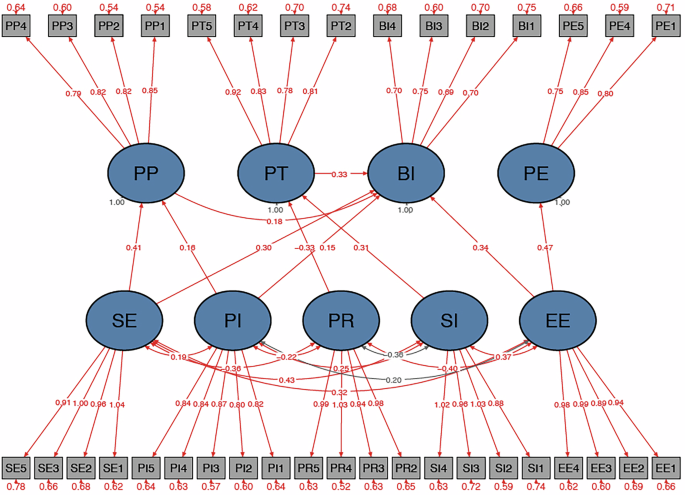
The questionnaire captured information on nine constructs—Performance Expectancy (PE), Effort Expectancy (EE), Social Influence (SI), Perceived Risk (PR), Perceived Trust (PT), Perceived Interactivity (PI), Perceived Pleasure(PP), Self-Efficacy (SE), and Behavioral Intention (BI). The final instrument contained 30 validated items (see Table 1 for scale details).
To establish content validity, we conducted expert reviews (n = 5) and a pilot test with university students (n = 50). The questionnaire was subsequently refined based on pretest results, including item clarity analysis (Cronbach’s α > 0.78 for all constructs) and completion time optimization.
Data collection
The survey was primarily administered via an online questionnaire platform (Wenjuanxing) and disseminated through social media channels (WeChat, Rednote groups) and targeted e‑mail invitations. A combination of snowball sampling and convenience sampling strategies was employed. The survey was initially promoted through the online platform to attract the first group of respondents. These initial participants were then invited to share the questionnaire with friends, family members, or other eligible contacts within their networks. While this approach facilitated a broader reach, it also carried the potential risk of sampling bias, as respondents might be more inclined to forward the survey to individuals with similar characteristics or interests.
The formal data collection commenced in early November 2024 and continued for one month, yielding a total of 585 completed questionnaires. To ensure data quality, all submissions were subjected to a rigorous screening process. Invalid questionnaires—such as those with excessively short completion times, abnormally high answer repetition rates, or multiple submissions from the same respondent—were excluded. After removing 69 invalid responses, a total of 516 valid questionnaires were retained, resulting in an effective response rate of 88.21%. Within the valid sample set, 43.41% of respondents were male, and 56.59% were female. Regarding age distribution, 14.15% of respondents were under 18, 37.21% were aged 18–25, 17.05% were between 26 and 30, 13.18% fell within the 31–40 age range, and 18.41% were over 40 years old.
link




:max_bytes(150000):strip_icc()/120325-oprah-soc-860665f9054143eeb0dd846dc28fa740.jpg "Oprah-Approved Clothes, Shoes, and Bags Start at on Amazon")
