


Pulles, K. et al. Emerging strategies for regeneration of historic urban sites: A systematic literature review. City, Cult. Soc. 35, 100539 (2023).
Google Scholar
Geng, L., Xue, M. & Li, J. Historic District Conservation: A Critical Review of Global Trends, Development in the 21st Century, and Challenges Through CiteSpace Analysis. Buildings 15, 1232 (2025).
Google Scholar
Lak, A., Gheitasi, M. & Timothy, D. J. Urban regeneration through heritage tourism: cultural policies and strategic management. J. Tour. Cultural Change 18, 386–403 (2020).
Google Scholar
Nian, S., Bao, J., Chen, Y., Zhang, X. & Chen, Y. How does the tourist experience affect the conservation of World Heritage Sites via the stimulus–organism–response model? Mount Sanqingshan National Park, China. npj Herit. Sci. 13, 21 (2025).
Google Scholar
Li, J., Shi, H. & Li, D. Research on Renewal Strategy of Historical and Cultural Blocks from the Perspective of Tourist Perception. J. Tour. Manag. 1, 1–12 (2024).
Wang, J. Problems and solutions in the protection of historical urban areas. Front. Architectural Res. 1, 40–43 (2012).
Google Scholar
Deacon, H. Conceptualising Intangible Heritage in Urban Environments: Challenges for Implementing the HUL Recommendation. Built Herit. 2, 72–81 (2018).
Google Scholar
Zhao, P., Ali, Z. M. & Ahmad, Y. Developing indicators for sustainable urban regeneration in historic urban areas: Delphi method and Analytic Hierarchy Process (AHP). Sustain. Cities Soc. 99, 104990 (2023).
Google Scholar
Doratli, N., Hoskara, S. O. & Fasli, M. An analytical methodology for revitalization strategies in historic urban quarters: a case study of the Walled City of Nicosia, North Cyprus. Cities 21, 329–348 (2004).
Google Scholar
ICOMOS, International Charter for The Conservation and Restoration of Monuments and Sites (The Venice Charter) – 1964. Available: [Accessed 21(2025)].
ICOMOS, Charter for the Conservation of Historic Towns and Urban Areas (Washington Charter, 1987). Available: [Accessed 21(2025)].
UNESCO, Recommendation on the Historic Urban Landscape. Available: [Accessed 21 May (2025)].
Cai, R. & Nasu, S. Adopting the ‘historic layering’ concept from the Historic Urban Landscape approach as a methodological framework for urban heritage conservation. Int. J. Herit. Stud. 31, 573–591 (2025).
Google Scholar
Zhang, H., Cong, C. & Chakraborty, A. Exploring the institutional dilemma and governance transformation in China’s urban regeneration: Based on the case of Shanghai Old Town. Cities 131, 103915 (2022).
Google Scholar
Wang, H., Zhao, Y., Gao, X. & Gao, B. Collaborative decision-making for urban regeneration: A literature review and bibliometric analysis. Land Use Policy 107, 105479 (2021).
Google Scholar
Liu, Z., Wang, S. & Wang, F. Isolated or integrated? Planning and management of urban renewal for historic areas in Old Beijing City, based on the association network system. Habitat Int. 93, 102049 (2019).
Google Scholar
Yung, H. K., Chan, H. W. C. & Xu, Y. Sustainable Development and the Rehabilitation of a Historic Urban District – Social Sustainability in the Case of Tianzifang in Shanghai. Sustain. Dev. 22, 95–112 (2011).
Google Scholar
Holladay, P. J. & Powell, R. B. Resident perceptions of social-ecological resilience and the sustainability of community-based tourism development in the Commonwealth of Dominica. J. Sustain. Tour. 21, 1188–1211 (2013).
Google Scholar
Vaquero, M.C. & Hernandez, M. G. Heritage Tourism and Visitor Management, In: E. Nikita, T. Rehren, Encyclopedia of Archaeology (Second Edition), Academic Press,2024, p. 597–605, https://doi.org/10.1016/B978-0-323-90799-6.00091-4
Zhang, T., Wei, C. & Nie, L. Experiencing authenticity to environmentally responsible behavior: Assessing the effects of perceived value, tourist emotion, and recollection on industrial heritage tourism. Front. Psychol. 13, (2022).
Genc, V. & Genc, S. G. The effect of perceived authenticity in cultural heritage sites on tourist satisfaction: the moderating role of aesthetic experience. J. Hospitality Tour. Insights 6, 530–548 (2023).
Google Scholar
Zuo, Y., Lan, T., Liu, S. & Zeng, H. The effect of place attachment on visitors’ revisit intentions: evidence from Batam. Tour. Geographies 22, 51–82 (2020).
Google Scholar
Isa, S. M., Ariyanto, H. H. & Kiumarsi, S. The Post-Effects of the Authenticity of Rural Intangible Cultural Heritage and Tourists’ Engagement. Behav. Sci. 14, 302 (2024).
Google Scholar
Xu, X., Xue, K. & Li, F. The effect of price perception on tourists relative deprivation and purchase intention. Curr. Issues Tour. 27, 59–75 (2024).
Google Scholar
Chen, C.-F. & Chen, F.-S. Experience quality, perceived value, satisfaction and behavioral intentions for heritage tourists. Tour. Manag. 31, 29–35 (2010).
Google Scholar
Park, E., Choi, B.-K. & Lee, T. J. The role and dimensions of authenticity in heritage tourism. Tour. Manag. 74, 99–109 (2019).
Google Scholar
Cheng, L. et al. Authentic experiences and visitor stickiness: When landscapes are restored at a world natural heritage site. Tour. Manag. 108, 105124 (2025).
Google Scholar
Ram, Y., Björk, P. & Weidenfeld, A. Authenticity and place attachment of major visitor attractions. Tour. Manag. 52, 110–122 (2016).
Google Scholar
Bryce, D., Curran, R., O’Gorman, K. & Taheri, B. Visitors’ engagement and authenticity: Japanese heritage consumption. Tour. Manag. 46, 571–581 (2015).
Google Scholar
Cheng, L., Ju, Y., Wang, T., Wall, G. & Li, J. M. Wang, Authenticity, involvement, and image: Evaluating tourist experiences at historic districts. Tour. Manag. 50, 85–96 (2015).
Google Scholar
Sasongko, G., Kameo, D. D., Siwi, V. N., Wahyudi, Y. & Huruta, A. D. The Effect of Service Quality and Heritage Tourism on Tourist Loyalty: The Case of Borobudur Temple. Heritage 8, 77 (2025).
Google Scholar
Bhogal, S., Mittal, A. & Tandon, U. Accessing vicarious nostalgia and memorable tourism experiences in the context of heritage tourism with the moderating influence of social return. Int. J. Tour. Consum. Res. 10, 860–880 (2024).
Alrawadieh, Z. & Prayag, G. A cognitive appraisal perspective of emotional accessibility at heritage sites: empirical evidence from the UNESCO World Heritage Site of Petra. J. Herit. Tour. 18, 145–163 (2023).
Google Scholar
Zhang, S. et al. Perception in cultural heritage tourism: an analysis of tourists to the Beijing-Hangzhou Grand Canal, China. J. Tour. Cultural Change 21, 569–591 (2023).
Google Scholar
Zou, Y., Yang, Y., Li, Y., Liao, J. & Xiao, H. How do tourists’ heritage spatial perceptions affect place identity? A case study of Quanzhou, China. J. Hospitality Tour. Manag. 55, 460–470 (2023).
Google Scholar
Bonn, M. A., Joseph-Mathews, S. M., Dai, M., Hayes, S. & Cave, J. Heritage/Cultural Attraction Atmospherics: Creating the Right Environment for the Heritage/Cultural Visitor. J. Travel Res. 45, 345–354 (2007).
Google Scholar
Kempiak, J., Hollywood, L., Bolan, P. & McMahon-Beattie, U. The heritage tourist: an understanding of the visitor experience at heritage attractions. Int. J. Herit. Stud. 23, 375–392 (2017).
Google Scholar
Song, H., Chen, J. & Li, P. Decoding the cultural heritage tourism landscape and visitor crowding behavior from the multidimensional embodied perspective: Insights from Chinese classical gardens. Tour. Manag. 110, 105180 (2025).
Google Scholar
Prayag, G. & Hosany, S. Understanding the Relationships between Tourists’ Emotional Experiences, Perceived Overall Image, Satisfaction, and Intention to Recommend. J. Travel Res. 56, 41–54 (2017).
Google Scholar
Nian, S., Li, D., Zhang, J., Lu, S. & Zhang, X. Stimulus-Organism-Response Framework: Is the Perceived Outstanding Universal Value Attractiveness of Tourists Beneficial to World Heritage Site Conservation?. Int. J. Environ. Res. Public Health 20, 1189 (2023).
Google Scholar
Mehrabian, A. & Russell, J.A. An Approach to Environmental Psychology, The MIT Press, (1974).
Li, Q., Li, S., Zhang, S., Hu, J. & Hu, J. A Review of Text Corpus-Based Tourism Big Data Mining. Appl. Sci. 9, 3300 (2019).
Google Scholar
Xu, Y. et al. Text mining-based analysis of ancient landscape and tourism behavior at Hangzhou’s West Lake. npj Herit. Sci. 13, 426 (2025).
Google Scholar
Liu, D., Thomas, M. A. & Li, Y. Natural language processing enhanced literature reviews. J. Inform. Technol. 0,1–27, (2025).
Sun, S., Luo, C. & Chen, J. A review of natural language processing techniques for opinion mining systems. Inf. Fusion 36, 10–25 (2017).
Google Scholar
Mao, Y., Liu, Q. & Zhang, Y. Sentiment analysis methods, applications, and challenges: A systematic literature review. J. King Saud. Univ. – Computer Inf. Sci. 36, 102048 (2024).
Google Scholar
Ankareddy, R. & Delhibabu, R. Dense Segmentation Techniques Using Deep Learning for Urban Scene Parsing: A Review. IEEE Access 13, 34496–34517 (2025).
Google Scholar
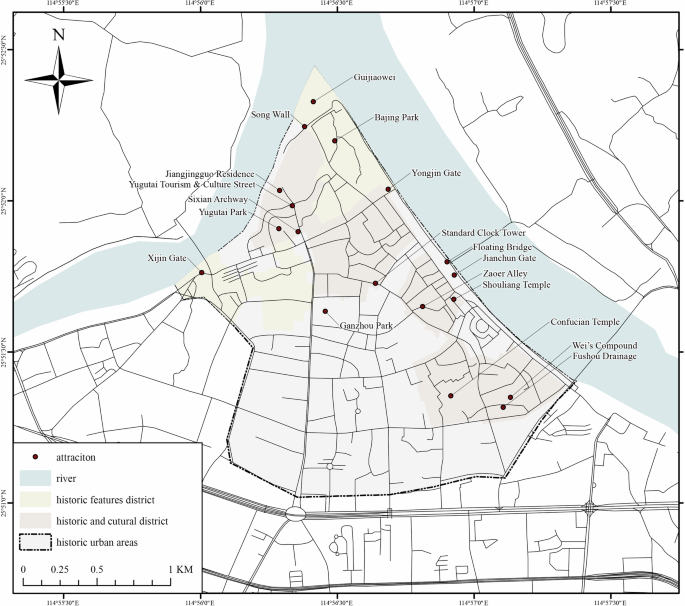
Committee for the Protection of Historic and Cultural City of Ganzhou, The Conservation Planning of Historic City of Ganzhou. Available: [Accessed 2025].
Blei, D.M., Ng, A.Y. & Jordan, M.I. Latent Dirichlet Allocation. J. Machine Learning Res. 3, 993–1022(2003).
Griffiths, T. L. & Steyvers, M. Finding scientific topics. Proc. Natl. Acad. Sci. USA 101, 5228–5235 (2004).
Google Scholar
Jelodar, H. et al. Latent Dirichlet allocation (LDA) and topic modeling: models, applications, a survey. Multimed. Tools Appl. 78, 15169–15211 (2019).
Google Scholar
Syed, S. & Spruit, M. Full-Text or Abstract? Examining Topic Coherence Scores Using Latent Dirichlet Allocation, 2017 IEEE International Conference on Data Science and Advanced Analytics (DSAA), Tokyo, Japan, 2017, pp. 165–174, https://doi.org/10.1109/DSAA.2017.61.
Fu, W. & Zhou, B. Theme Exploration and Sentiment Analysis of Online Reviews of Wuyishan National Park. Land 13, 629 (2024).
Google Scholar
Wang, J., Xia, Y. & Wu, Y. Sensing Tourist Distributions and Their Sentiment Variations Using Social Media: Evidence from 5A Scenic Areas in China. Int. J. Geographical Inf. Sci. 11, 492 (2022).
Cheng, B., Misra, I., Schwing, A. G., Kirillov, A. & Girdhar, R. Masked-attention Mask Transformer for Universal Image Segmentation, arXiv, (2022).
Mapillary Vistas Dataset, Available: [Accessed 2025].
Hoerl, A.E. & Kennard, R.W. Ridge Regression: Biased Estimation for Nonorthogonal Problems. Technometrics. 12 (1970).
Pai, C., Zhang, Y., Wang, Y.-L., Li, K. & Shang, Y. Current challenges and opportunities in cultural heritage preservation through sustainable tourism practices. Curr. Issues Tourism. 1–19, (2025).
Li, Y. et al. Evaluating tourist perceptions of architectural heritage values at a World Heritage Site in South-East China: The case of Gulangyu Island. J. Hospitality Tour. Manag. 60, 127–140 (2024).
Google Scholar
Yu, B., Sun, J., Wang, Z. & Jin, S. Influencing Factors of Street Vitality in Historic Districts Based on Multisource Data: Evidence from China. Int. J. Geographical Inf. Sci. 13, 277 (2024).
Willson, G. B. & McIntosh, A. J. Heritage Buildings and Tourism: An Experiential View. J. Herit. Tour. 2, 75–93 (2007).
Google Scholar
Wang, W., Chen, J. S., Fan, L. & Lu, J. Tourist experience and Wetland parks: A case of Zhejiang, China. Ann. Tour. Res. 39, 1763–1778 (2012).
Google Scholar
Flint, A. & Jennings, B. The role of cultural heritage in visitor narratives of peatlands: analysis of online user-generated reviews from three peatland sites in England. Int. J. Herit. Stud. 28, 163–179 (2022).
Google Scholar
Luo, Y., He, J., Mou, Y., Wang, J. & Liu, T. Exploring China’s 5A global geoparks through online tourism reviews: A mining model based on machine learning approach. Tour. Manag. Perspect. 37, 100769 (2021).
Chai, C., Song, Y. & Qin, Z. A Thousand Words Express a Common Idea? Understanding International Tourists’ Reviews of Mt. Huangshan, China, through a Deep Learning Approach. Land 10, 549 (2021).
Google Scholar
Wang, J., Fan, W. & You, J. Evaluation of tourism elements in historical and cultural blocks using machine learning: a case study of Taiping Street in Hunan Province. npj Herit. Sci. 13, 30, (2025).
Ding, J., Tao, Z., Hou, M., Chen, D. & Wang, L. A Comparative Study of Perceptions of Destination Image Based on Content Mining: Fengjing Ancient Town and Zhaojialou Ancient Town as Examples. Land 12, 1954 (2023).
Google Scholar
Pan, Y., Nik Hashim, N. H. & Goh, H. C. Public perception of cultural ecosystem services in historic districts based on biterm topic model. Sci. Rep. 14, 11717 (2024).
Google Scholar
Rasoolimanesh, S. M., Seyfi, S., Rather, R. A. & Hall, C. M. Investigating the mediating role of visitor satisfaction in the relationship between memorable tourism experiences and behavioral intentions in heritage tourism context. Tour. Rev. 77, 687–709 (2022).
Google Scholar
Skotis, A. & Livas, C. A data-driven analysis of experience in urban historic districts. Ann. Tour. Res. Empir. Insights 3, 100052 (2022).
Google Scholar
Zuo, Y., Lan, T., Liu, S. & Zeng, H. The Post-Effects of the Authenticity of Rural Intangible Cultural Heritage and Tourists’ Engagement. Behav. Sci. 14, 302 (2024).
Google Scholar
Relph, E. Place and Placelessness, London: Pion, (1976).
Lynch, K. The Image of the City, The MIT Press, (1960).
Huang, J., Liang, J., Yang, M. & Li, Y. Visual Preference Analysis and Planning Responses Based on Street View Images: A Case Study of Gulangyu Island, China. Land 12, 129 (2022).
Google Scholar
Huang, J., Hu, X., Wang, J. & Lu, A. How Diversity and Accessibility Affect Street Vitality in Historic Districts? Land 12, 219 (2023).
Google Scholar
Zhang, Y. & Han, Y. Vitality evaluation of historical and cultural districts based on the values dimension: districts in Beijing City, China. Herit. Sci. 10, 137 (2022).
Google Scholar
Ma, X. et al. Measuring human perceptions of streetscapes to better inform urban renewal: A perspective of scene semantic parsing. Cities 110, 103086 (2021).
Google Scholar
Yin, L. & Wang, Z. Measuring visual enclosure for street walkability: Using machine learning algorithms and Google Street View imagery. Appl. Geogr. 76, 147–153 (2016).
Google Scholar
Douglas, I. Urban ecology and urban ecosystems: Understanding the links to human health and well-being. Curr. Opin. Environ. Sustainability 4, 385–392 (2012).
Google Scholar
Dillen, S.M., Vries, S. & Groenewegen, P.P. Greenspace in urban neighbourhoods and residents’ health: adding quality to quantity. Epidemiol. Commun. Health. 66, (2011).
Tsurumi, T., Imauji, A. & Managi, S. Greenery and Subjective Well-being: Assessing the Monetary Value of Greenery by Type. Ecol. Econ. 148, 152–169 (2018).
Google Scholar
Zhao, G., Ryan, C., Deng, Z. & Gong, J. Creating a softening cultural landscape to enhance tourist experiences: The case of Lu Village. Tour. Manag. Perspect. 53, 101245 (2024).
Zhou, M. & Yang, J. Geospatial Spatiotemporal Analysis of Tourism Facility Attractiveness and Tourism Vitality in Historic Districts: A Case Study of Suzhou Old City. Land. 14, 922. (2025).
Zhao, Q., Zhang, L. & Hou, J. Developing a cultural sustainability assessment framework for environmental facilities in urban communities. npj Herit. Sci. 13, 107 (2025).
Wang, Y., Hu, W., Park, K.-S., Yuan, Q. & Chen, N. Examining residents’ support for night tourism: An application of the social exchange theory and emotional solidarity. J. Destination Mark. Manag. 28, 100780 (2023).
Yan, L., Chen, Y., Zheng, L. & Zhang, Y. Research on the quantification of historical street space based on image semantic segmentation. ICCAID 2021. 1216814 (2022).
link