
Exploring the value creation mechanism of agricultural heritage creative tourism based on SEM and fsQCA
Literature review and research hypothesis
We begin with a review of Value co-creation theory. The theory of value co-creation, introduced by Richard and Rafael, highlights the dynamic interactions between multiple stakeholders as a core mechanism for innovation26. It emphasizes the delivery of products or services through collaborative efforts, fostering innovation via multi-stakeholder engagement15. According to existing studies, the theory comprises three main dimensions: value co-creation theory based on customer experience, value co-creation theory based on service-dominant logic, and value co-creation theory based on customer-dominant logic27,28. This study adopts the service-dominant logic as a framework to address value co-creation in agricultural heritage tourism sites, focusing on the creation of usage value and situational value. In the tourism context, the service-dominant logic emphasizes tourists as co-creators involved in the tourism chain rather than passive consumers12,22. It also links tourist services to the concept of usage value28.
In the context of heritage tourism, the theory is mainly used to construct and interpret the services of heritage or provide an interpretive system of what belongs to the community of its heritage site29. The theory suggests that value comes from the interactive process between the provider and the consumer. For example, in creative tourism, tourists and residents create and perform creative tourism experiences by engaging in co-creation and performance. The experiences further stimulate tourists’ interest in the local culture. Tourists simultaneously engage in activities to gain skills and self-expression dimensions23. In addition, from an experiential perspective, tourists share spaces without verbal contact or communication by interacting with residents or even by extension. A link of interest is created between them to participate in the value co-creation process20,30,31.
Value co-creation theory provides a robust theoretical framework. It helps to explore in depth the process of individual self and external influences on the willingness of tourists and residents to co-create value together. The framework explains the relationship between creative performance and value co-creation at IAHS. The content of creative performance includes not only the foundational experiences that tourism providers build to enhance consumer perceptions but also includes the operational resources of tourism. Furthermore, it motivates tourists to become essential participants in the process of creating value and increasing product attractiveness through skills, expectations, and prior knowledge endowed by the external environment32. Thus, heritage sites gain a competitive advantage over traditional cultural tourism23. Meanwhile, cultural heritage tourism also creates more profound perceptions. It combines emotional meaning with tangible cultural places33. From a cognitive perspective, tourists explore agricultural heritages to find a feeling that aligns with childhood experiences. It will result in a particularly emotional process towards agricultural heritage. Therefore, individuals’ cognition associated with it will change16. On this basis, tourists form a value co-creation attitude by utilizing exchangeable resources and participating in spontaneous cultural protection34. From the external cultural environment perspective, tourists learn relevant experiences and skills of regional residents by acquiring farming knowledge. Tourists generate interactive awareness and concepts among local residents through cooperation between the community and collective learning. So tourists could realize the preservation of farming cultures16.
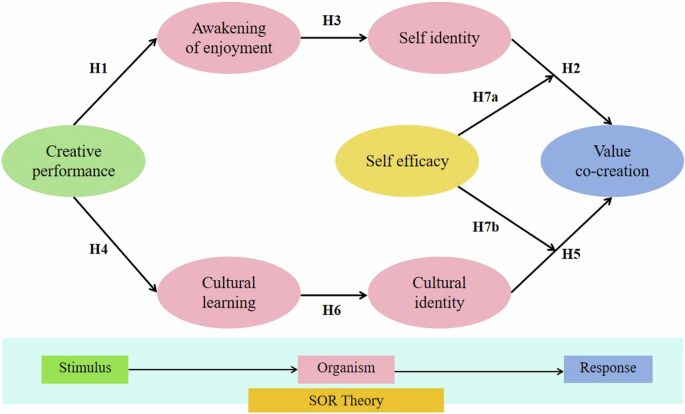
Therefore, the value co-creation theory helps us to explore how individuals receive expressions of creative performance elements and how relevant theories influence tourists’ willingness to co-create values at IAHS. Accordingly, this study proposes a theoretical model, as shown in Fig. 1.

Diagram of theoretical model.
Moreover, according to the stimulus-organism-response (SOR) theory, the creative elements of agricultural heritage sites act as external stimuli that may trigger a series of tourist behaviors. Firstly, the creative performance of heritage sites acts as an external stimulus to shift heritage site merchandise from the long term through tangible heritage with traditional unique values to intangible culture in everyday life. Tourists’ sense of experience, participation, and interaction changes psychologically and behaviorally with creative content elements. In addition, in the transition process from perception to identity, self-identity is based on self-awareness and self-perception by tourists. The tourists become creators, and creative elements awaken satisfaction in the tourists. It forms a differentiated understanding of tourists about the process of environment and identity when it is associated with positive emotions. This process usually involves a shift from positive attitudes to the behaviors of tourists35. Therefore, self-identity depends more on the tourists’ superficial perception of the heritage site and individual identity characteristics. Cultural identity indicates tourists’ recognition, acceptance, and emotional connection to the culture of heritage tourism36.
Prior studies have shown that studying a series of cultural heritage activities is beneficial in enhancing tourists’ perception of the unique heritage atmosphere. At the same time, related studies also help tourists and residents form interactions with cultural heritage through learning about heritage knowledge37. Therefore, tourists stimulated by creative tourism of agricultural heritage may stimulate a sense of self-identity (self-driven) and cultural identity (external environment-driven) with the heritage tourism site. Finally, self-efficacy is an essential factor influencing tourists’ motivation, emotions, and actions to be involved in community interactions15,38. Relevant studies have shown that sustainable tourism is accelerated when local communities have a high level of capacity and skills to deal with possible issues related to rural tourism development in the community.
Therefore, this study introduces self-efficacy as an element of an individual’s cognition and perception of the external environment and explores its moderating role39,40. With this in mind, this study provides a comprehensive understanding of how the creative performance of IAHS affects the value co-creation willingness of tourists to heritage sites.
Second, we explore the mediating role of the awakening of enjoyment and self-identity. Awakening of enjoyment is mainly derived from consumer behavior and tourism psychology. It involves an individual’s perception of the level of fun and pleasure in participating in an activity, and a reflection of external environmental stimuli41. In the field of tourism, the awakening of enjoyment refers to the feelings of joy, fun, and pleasure associated with tourism activities42. Previous studies have shown that the awakening of enjoyment positively predicts changes in tourists’ attitudes and destination visit intentions43.
Tourists become creators and develop a different understanding of the heritage environment and the identification process. This stimulates the satisfaction and joy of tourists towards the agricultural heritage sites and becomes a critical factor in awakening the pleasure of tourists24. However, few studies have examined tourists’ awakening of enjoyment during agricultural heritage tourism10. Cognitive appraisal theory suggests that emotions stem from a potential assessment of tourists’ well-being44. Self-identity refers to the process by which an individual seeks out a cultural group and acquires a sense of belonging45. Several studies have shown that the awakening of enjoyment helps convey the emotional factors individuals associate with specific behaviors41. Tourists’ satisfaction and joy with IAHS will enhance identification with engaging in heritage tourism activities42. The SOR theory suggests that creative elements act as external stimuli to elicit positive emotions from tourists and prompt individual tourists to respond to that stimulus.
In addition, some scholars have stated that tourists’ enjoyment is stimulated when satisfaction is linked to emotions. This will result in more value creation35. According to the co-creation of value theory, value co-creation between tourists and residents is related to the co-creation of enjoyable, engaging, and entertaining experiences between stakeholders16. Therefore, tourist pleasure could act as a cognitive factor. So, it facilitates the transition from perception to identification. Tourists will get a sense of belonging from the heritage site. That will stimulate the willingness to interact with residents. In addition, tourists can be integrated into heritage roles on psychological and emotional levels by participating in the co-production of heritage tourism. Furthermore, tourists could also explore and select heritage sites according to tourists’ interests. At the same time, tourists could also co-create tourism experiences with local community members36.
Overall, the formation of tourists’ self-identity through the creative performance of IAHS can be transmitted through the awakening of enjoyment as a mediating variable. The formation of tourists’ awakening of enjoyment on the willingness to co-create values can be transmitted through self-identity, according to which the hypotheses are formulated as follows.
H1: Awakening of enjoyment mediates between creative performance and self-identity.
H2: Self-identity mediates between the arousal of pleasure and the willingness of tourists to value co-creation.
H3: Awakening of enjoyment and self-identity mediate the chain between creative performance and value co-creation.
Thirdly, we analyze the mediating role of cultural learning and cultural identity. In the field of tourism, cultural learning is viewed as an essential motivation for traveling, which indicates tourists’ interest in special events and the evaluation of the destination’s image during the trip46. On the other hand, cultural identity is an internal state dependent on self-perception47,48. In the process of cultural tourism, cultural identity reflects the degree to which tourists use it to recognize and identify with cultures, and cultural identity makes distinctions between particular cultures and others49. It is a presentation of the positive feelings of tourists used to emphasize intrinsic differences. In the field of creative tourism, scholars have explored the vital role of cultural learning and cultural identity from the perspective of tourists and other subjects10.
According to the value co-creation theory, the co-creation of agricultural heritage values benefits the acquisition of agricultural heritage knowledge, learning experiences, and skill development50. Furthermore, creative and traditional tourism experiences imply a more direct interaction between tourists and residents. Creative elements act as a medium. Meanwhile, creative elements are an essential source of expertise local tourists seek. Creativity helps to reverse the usual home-away-from-home power relations23. In addition, some scholars have found that, on the one hand, the interaction and exchange of information between tourists and residents enhances the educational value. It motivates residents to realize their creative potential in community cooperation and interactive collective learning processes with tourists. Thus, it contributes to the local realization of cultural preservation51. On the other hand, creative individuals and communities at cultural heritage sites can utilize the heritages’ skills, traditions, and cultural knowledge. This will facilitate the co-creation of value in heritage sites52. Cultural identity theory suggests that tourists’ identification with the destination’s culture significantly impacts attitudes toward participation in the tourist community36,47. The educational motivation for tourists to participate in heritage site tourism is to learn new things about history and culture18. Tourists may also be stimulated by the creative elements of IAHS. So, tourists spontaneously learn the historical and cultural knowledge embedded in the heritage site. It will lead to a shift from cognition to identification. In addition, if tourists are able to identify with the cultural practices and values of the heritage site, tourists will be more willing to participate in the local community and create value for the heritage site. Accordingly, the following hypotheses are proposed:
H4: Cultural learning mediates between creative performance and cultural identity
H5: Cultural identity mediates between cultural learning and tourists’ willingness to co-create values
H6: Cultural learning and cultural identity mediate the chain between creative performance and willingness to co-create values
Finally, we analyze the moderating role of self-efficacy. Self-efficacy refers to an individual’s judgment of whether or not he or she can perform a task in a given location38,40. Self-efficacy stems from an individual’s motivation and attitude to participate in local community activities. It is crucial in influencing tourists’ subjective attitudes and behaviors. Moreover, self-efficacy influences tourists’ behaviors in participating in the organization, execution, and completion of tasks in local tourism communities. On the one hand, tourists become active contributors to positive value co-creation when individuals have the moral responsibility, awareness, and beliefs to accomplish the goals. This will help to establish sharing norms and concepts of commitment, trust, and reciprocity in the sharing process and share high-quality content for the community to create more excellent value15. On the other hand, under social cognitive theory, according to social cognitive theory, individuals function within an interconnected causal framework, where cognition, behavior, and environment all serve as determinants of interactions. Positive self-efficacy plays a crucial role in value co-creation. Thus, shared norms, responsibilities, and reciprocity are established in the co-creation process53.
In addition, previous research has shown that self-efficacy moderates the relationship between consumers and the environment in the service-dominant logic of value creation38. However, there may be differences in the acceptance of tourists’ ability to cope with the challenges of the surroundings54. Depending on the differences in the surroundings, tourists with low self-efficacy cannot ensure that the communities’ traditions and cultural values are adequately maintained in agricultural heritage communities. People with low self-efficacy cannot take responsibility for creating quality content for the community, and insufficient creativity limits ideas. This process could be more conducive to value creation55. This paper suggests that self-efficacy plays a moderating role between self-identity and willingness to co-create values. It also has a moderating role in the process of influencing cultural identity and willingness to co-create values. Accordingly, this study proposes the following hypotheses:
H7a: Self-efficacy has a moderating role in the effect of self-identity on willingness to co-create values
H7b: Self-efficacy has a moderating role in the effect of cultural identity on willingness to co-create values
Methods of econometric modeling
The principles of structural equation modeling (SEM) is shown in the following equation. Structural equation modeling (SEM) allows the treatment of latent and observed variables and the relationships within an integrated framework56. Equations (1) and (2) give the measurement models for endogenous and exogenous variables, respectively.
$${\rm{y}}={\varLambda }_{y}\eta +\varepsilon$$
(1)
$$x={\varLambda }_{x}\xi +\delta$$
(2)
Where y is a p ×1 vector of endogenous observed variables, x is a q × 1 vector of exogenous observed variables, η is a m ×1 vector of potential endogenous variables, and ξ is a n × 1 vector of potential exogenous variables. Furthermore, Λy and Λx are the coefficients’ p × m and q × n matrices (or loadings). Finally, ε and δ are the p × 1 and q × 1 vectors of measurement error for y and x, respectively.
$$\eta ={\rm B}\eta +\varGamma \xi +\zeta$$
(3)
Moreover, η and ξ are defined in (1) and (2). B is an m × m matrix, and βij represents the jth endogenous latent variable ith endogenous latent variable in the label Eq. (3). Γ is an m × n matrix, where γij denotes the effect of the jth exogenous latent variable on the ith endogenous latent variable. ζ is a vector of m × m perturbations. In this study, B is the coefficient matrix of creative performance. Γ is the coefficient matrix of value co-creation willingness ξ,and ζ is the residual vector.
The moderated effects model is shown in the following equation. In this case, Eqs. (4) and (5) represent the principles of regulatory effects, where the causal effect of D on Y is said to be moderated by M. If β3 > 0, the positive effect of D on Y increases with M (or the negative effect decreases with M). while if β3 < 0, the positive effect of D on Y decreases with M (or the negative effect increases with M).
$$Y={\beta }_{0}+{\beta }_{1}D+{\beta }_{2}M+{\beta }_{3}M\times D+\varepsilon$$
(4)
$$\frac{\partial E(Y/\bullet )}{\partial D}={\beta }_{1}+{\beta }_{3}M$$
(5)
The principle of the mediated effects is shown in the following equation. Y is the outcome variable, corresponding to the willingness to value co-creation in this study; D is the disposition variable, corresponding to the creative performance of IAHS in this study; and M is the mediating variable, corresponding to “the awakening of enjoyment” – “self-identity” and “cultural learning” – “cultural identity,” respectively. Equation (6) indicates that the creative performance of IAHS has a causal effect on tourists’ value co-creation willingness. Equation (8) indicates that the mediating variables, i.e., “the awakening of enjoyment” – “self-identity,” have a causal effect on value co-creation, and “cultural learning” – “cultural identity” also has a causal effect on value co-creation. Thus, the causal chain of “Creative performance →Awakening of enjoyment →Self-identity →Willingness to value co-creation” and “Creative performance →Cultural learning →Cultural identity →Value co-creation” is established in Eq. (7). In addition to this, it is indicated that creative performance may also affect the willingness to co-create values, in addition to the role of mediating effects.
$$\varUpsilon ={\alpha }_{0}+{\alpha }_{1}D+{\varepsilon }_{Y1}$$
(6)
$$\varUpsilon ={\beta }_{0}+{\beta }_{1}D+{\beta }_{2}M+{\varepsilon }_{Y2}$$
(7)
$$M={\gamma }_{0}+{\gamma }_{1}D+{\varepsilon }_{M}$$
(8)
Data collection
According to the globally important agricultural heritage systems (GIAHS) list, the Anxi Tieguanyin Tea Culture System is located in Fujian Province, China. It is newly inscribed as a GIAHS in 2022. So, it is considered the case site for this study. Fujian Province is recognized as one of China’s essential cultural heritage protection areas, with unique traditional lifestyles and cultural and historical styles36. In recent years, various tea cultural heritage sites in Fujian Province have tried to join the ranks of GIAHS. This initiative has promoted the integration of regional cultural heritage and creative tourism. Therefore, this study’s data source is the representative IAHS in the tea category in Fujian Province, China57. Figure 2 shows the tea culture tourism and characteristic activities in Fujian Province, which is an important manifestation of the value of agricultural heritage. It includes the survey of the jasmine planting and tea culture system in Fuzhou, the Tieguanyin tea cultural system in Anxi, and the white tea cultural system in Fuding, Fujian, and Youxi, Fujian10. Therefore, the case is typical and representative.

Fujian Tea Cultural Tourism Destination “Doucha” Competition (Figure sourced from Anxi News Network: http://www.mnw.cn/quanzhou/anxi/).
First, it was ensured that respondents were tourists who had visited the tea agricultural heritage site. Second, two doctoral and four master’s students who participated in the study were given pre-questionnaire training. The pre-questionnaire training mainly included that the researchers should explain the background and purpose of the study to the respondents. In addition, personal privacy should not be involved in the survey process. Third, the questions in the questionnaire that were ambiguous or difficult to understand should be corrected to make it easier for the respondents to read and understand the questions. Fourth, the email contact information was added to the description part of the questionnaire so that some online respondents could contact us when respondents surveyed had questions. Fifth, the keywords in the official questionnaire were bold to facilitate the respondents’ reading and understanding. Sixth, respondents were asked to complete the questionnaire based on their experiences and perceptions. After the completion of the questionnaire, the relevant personnel checked whether there were any mistakes or omissions and gave the respondents a small gift as a token of appreciation.
The collection of questionnaires lasted from April 2021 to November 2022, with a total of 550 questionnaires distributed online and offline. Firstly, the study conducted a pre-survey and adjusted the questionnaire items based on the pre-survey. Secondly, a total of 550 questionnaires were distributed online and offline during the formal distribution phase, and 537 were recovered56. Then, the researchers excluded 131 samples that didn’t answer carefully. Lastly, 406 valid questionnaires were obtained. The effective recovery rate of the questionnaires was 73.81% when the number of valid questionnaires 406 was divided by the total number of 550 questionnaires researchers collected as described above. Researchers measured a total of 22 questions (Table 2), while the valid sample was 406. According to Ranatunga et al. (2020). and Hair et al. (2011)58,59, the determination of minimum sample size is related to the minimum R2 in the model and the maximum number of arrows pointing at a construct. In this study, the maximum number of arrows pointing at a construct is five, and the minimum R2 in the model is 0.362. Therefore, according to the relevant studies, the minimum sample size for this study should be 50. Our sample size is 406, which satisfies the minimum sample size.
Therefore, the number of valid questionnaires fulfilled the requirement that the valid sample size was ten times the number of questions measured36, and this research was valid. The descriptive statistics of the respondents are shown in Table 1.
Measurements
The variables in this study mainly refer to the published scales of authoritative journals to measure the dimensions: First, creative performance refers to Song’s (2022) five-question items on creativity, which reflect tourists’ comprehensive views on innovation and creativity in tourism at tea culture heritage sites10; Second, awakening of enjoyment is measured by referring to the five items of ref. 43; Third, cultural learning refers to Hung’s (2019) four items for measuring tourists’ cultural learning during tourism60; Fourth, cultural identity adopts Zhang et al.‘s (2019) four items61; Fifth, self-efficacy refers to Wang and Netemeyer’ s self-efficacy scale(2004), which consists of three question items62; Sixth, this paper refers to Cheek’s (2018) method for determining self-identity dimensions63; Seventh, this paper refers to Lin et al. (2017) scale on residents’ willingness to co-create values in heritage site communities64. This study constructs variables based on the following indicators in Table 2.
Data analysis
In Table 3, Cronbach’s alpha of value co-creation willingness, self-identity, cultural identity, awakening of enjoyment, cultural learning, and self-efficacy are 0.863, 0.757, 0.838, 0.877, 0.849, and 0.788, respectively, which are more significant than 0.65 in the ideal value. Results indicate that the overall questionnaire items have high internal consistency and strong correlation. In addition, the standardized factor loading for each item in Table 3 is higher than 0.615 (higher than 0.60). In terms of the internal fitness test, the Composite Reliability (CR) values of all variables are more significant than 0.7. The results indicate that the research constructs can better reflect the variance of the explanatory variables if this study selects the seven variables. All variables’ average variance extracted (AVE) are more significant than 0.5. Results indicate that the internal consistency of the variables is good. Overall, the measurement model has good stability and aggregation. In order to avoid the problem of multicollinearity between variables and variables, the variance inflation factor (VIF) of each variable is measured. The VIF of seven variables is below 2.261. This indicates that there is no problem of multicollinearity between different variables. Table 3 describes the mean, standard deviation, correlation, and square root of the mean variance of the seven constructs. Then, as results can be seen in Table 4, comparing the ranks’ magnitude shows differential validity and reliability among the seven constructs. In addition, Harman’s one-way test is used to calculate the loading of all indicators, and the results show that there is no standard method bias problem for the above variables.
Validation factor analysis
In order to prevent common method bias in the overall model, this study conducts a first-order validation factor test of the overall model against the modified model. In carrying out the structural equation test for this study, the study applies the overall model fit index37, and the results show that the seven-factor model shows a better fit (χ2 = 300.290, p < 0.001; χ2/df = 1.597; CFI = 0.979; IFI = 0.979; TLI = 0.974; NFI = 0.945; GFI = 0.937; AGFI = 0.915; RMSEA = 0.038).
link




:max_bytes(150000):strip_icc()/120325-oprah-soc-860665f9054143eeb0dd846dc28fa740.jpg "Oprah-Approved Clothes, Shoes, and Bags Start at on Amazon")
